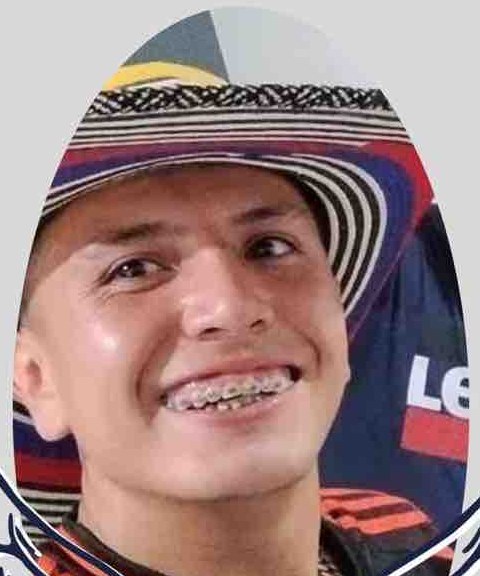
“Since that day, I have lost half my heart, but in another life, I know we'll have another opportunity.”
So goes the song “En Otra Vida,” by Kei Linch and Almanegra, an ode to a lost love played on Art Hill in St. Louis, Missouri, during a vigil held in honor of a fallen son. One thing that comes across in his story, and indeed, when discussing his life with his mother, is just how well loved he was and how much of that love he returned. As his mother told The VoICE Project, “My son’s only sin was loving his family, loving me. He witnessed so many humiliations and hardships I went through to provide for them.” And perhaps that is the worst part of this tragedy: his last notes, begging to speak to his mother, suggest that being cut off from that love was part of what drove him to suicide.
In our first memorial, you will learn the story of Brayan Estiven Rayo Garzón, a young man from Bogotá, Colombia, who came to the U.S. hoping to build a safer life with his cherished family. His mother describes him as the man of the house: a provider and a good son who fought to bring her here so he wouldn’t come alone, and who wanted his sisters and his mother to get ahead. At her request, his mother is identified here only as his mother.
The VoICE Project’s focus is not only on the deaths of those victimized by ICE but also their lives, and so we begin with the reporting available to us regarding how he lived and who he was. Brayan’s case is somewhat exceptional in that strong local and national reporting gives us an unusually clear picture of his story. I believe you will find, as I did, that his mother’s impressions of who he was are clear in all the events of his life, to the very end, where in his final act, through the decision of his mother, he saved the lives of five people in our country via organ donation.
Life
Brayan Estiven Rayo Garzón was a 27-year-old man living in St. Louis, Missouri. He came to the city with his family via the southern border near San Ysidro, California, in 2023. In life, he enjoyed traveling the city on his motorcycle, watching his favorite team, Atlético Nacional, with his friends, and sledding down Art Hill whenever it was covered in snow. His work in the United States was of a fashion that is typical for immigrants in the country: some handyman work like painting houses, and as a food delivery service worker.
Like many of us, he dreamed of providing for those he loved. According to his mother, “He only wanted to give us a home of our own so I wouldn’t have to work, and to have his own business and from there give me a better life.” One day that dream may have included a wife and children of his own, but that isn’t something we can ever know. I mention this because it is vital to the portrait of a man, a son who wanted better for the people he loved. That is who Brayan was, not just a name on a list of the dead but a person, with all the hopes, dreams, and struggles with which personhood endows all of us.
In the roughly 16 short months he lived here, three of them in detention, he had hoped to save money to hire an immigration lawyer, and more than anything, he desired to stay with his family. Hailing originally from Bogotá, Colombia, where he worked first in the military and then later as a street vendor, Brayan had a strong care for and love of his family, in particular his mother, whom he accompanied to the border along with his sisters, fleeing potential danger back home. In fact, it was Brayan who convinced his mother and sisters to leave Bogotá in the first place, and his mother says he fought tooth and nail to give them a better life here.
The Journey In
We often skip over the specifics of why people leave their homes and take the long, dangerous journey to our “shining city on a hill.” In the case of the Garzón family, St. Louis Public Radio reported of his mother that “her family’s time in Bogotá became more and more challenging over a span of months. It ultimately reached a breaking point at the end of 2023.” According to his mother, “The reasons for our migration are very personal.” Infer from that what you will, and while you’re inferring, consider what it would take for you to leave everything you know behind.
Speaking to St. Louis Public Radio about their time in Bogotá, his mother said, “We know [in Colombia], there may be laws, and you may be able to sue, but nothing will happen… Filing a lawsuit is putting your life in jeopardy.” And so, the family made the difficult decision to come to the U.S. in the hope of a better life. After two failed attempts, on the third, in the early hours of November 30, 2023, they crossed.
Settling
I want to be clear about this crossing: it was not an escape into the shadows, and they did not slip past anyone. The family was met and processed by Border Patrol and went directly into the justice system from there. If there is a “right way” to immigrate here, I would count that approach as part of it.
Owing to U.S. policy, this is where the family’s paths split. Border Patrol processes parents with minor children as a family unit; adult children, even those crossing with their parents, are processed on their own. Of the immigration agents at the border, his mother has said, “We were being treated like livestock. They threw my son’s money on the ground and made him pick it up on his knees.” His mother and sisters were quickly released into the country with their own ongoing review, whereas Brayan was held back for months.
After three months in detention, he was released to join his family in St. Louis, Missouri, but his immigration case remained in court back in San Diego. He missed his hearing there, and on June 12, 2024, roughly three months after his release, an immigration judge ordered him removed to Colombia in absentia. Despite this, an ICE record referenced in the AP’s investigation showed that the agency considered him a laborer who was a low risk to public safety.
It’s understandable if, upon hearing “Brayan skipped an immigration court hearing,” you throw your hands up in the air and say, “See? How is that the right way?” But consider the geography here. The family had only recently arrived. They spoke no English, had no money, and lived roughly 1,800 miles from the court, without the knowledge that they could ask to have the case moved to Missouri. His mother says they couldn’t afford to send him back to California. Under those conditions, how was he supposed to get to court?
That’s the rub: these cases are always more complicated than they look on the surface.
Encounters with the Law
The designation as a low risk is important to keep in mind as we move into the next portion of Brayan’s story: the challenges he faced with the law while here in the country.
First, he was cited once for shoplifting under a municipal ordinance in May 2024 in the town of Shrewsbury. He was accused of eating a chicken in the store and concealing a second item without paying. In speaking with his mother about this incident, it was clear she felt it was a misunderstanding. In her words, “My son made two mistakes that are very wrong. I don’t justify them, but I think young people make a lot of mistakes. The first was eating a chicken inside a store, which as far as I know he was going to pay for, but he started eating it before. I’m not saying this as a witness, but that’s what my son told me.” His own mother admits, “Either way, what he did was wrong.” And yet the criminal mind, mens rea, is half of the equation we consider when judging guilt. It is still a crime, but it’s also just… food, a chicken eaten in the aisle, and it is hard to read it as the act of a hardened criminal. The case was handled as a municipal ordinance violation rather than a state charge. When he missed his January 2025 court date in that case, the municipal court issued a warrant for his arrest at the end of that month.
Then, in March 2025, Brayan was accused of using a stolen credit card. It’s this charge that eventually led to his death, and it is a category difference from the others. As his mother describes it, “The other, more ‘serious’ one was making a purchase with a card from a friend, someone we had helped and reached out a hand to. He gave it to him to make that purchase, but my son didn’t know where the card really came from. But in the video they only looked at who swiped the card, and to our bad luck the only one was my son. But the real thief was someone else.”
The public record supports part of her account. According to the probable cause statement, as reported by St. Louis Public Radio, Brayan didn’t steal the card; he was given it by another man, Cristian Acuña, whom prosecutors charged with stealing cards from a hotel. The charge against Brayan stemmed from a purchase at The Nic, a vape shop on Delmar Boulevard, and the owner of another store accused him of trying to buy a bracelet with a stolen card. He was charged with a misdemeanor, not a felony. The court record sits behind a login on Missouri’s court system, so The VoICE Project could not review it ourselves, but we have no reason to doubt STLPR’s reporting.
Did Brayan know the card was stolen? According to the same statement, he told officers the man who gave it to him said it was stolen. But his mother says Brayan told her he didn’t know. His mother also told us he never had a criminal record in Colombia. These are exactly the gray-zone details a trial exists to sort out, and Brayan never got one. We don’t know what a rigorous prosecution and defense would have found.
Maybe this feels overly generous to Brayan, and you’d be forgiven for finding him a somewhat unsympathetic character on first meeting these facts. It should be acknowledged that this, along with the missed hearing in San Diego, made Brayan eligible for and likely to face deportation under any administration. But the punishment for these crimes, had he been convicted, is a little jail time, maybe a fine, maybe a deportation. It is absolutely not death.
Neglected to death? Isolated and ignored into suicide? That is not a lawful punishment under any administration, and under this one, it has become disturbingly common: the AP counted at least 10 suicides in ICE custody between January 2025 and its investigation earlier this year, when the agency has usually recorded one or none a year. Even if you are inclined to believe this administration’s approach is just, none of what we know about Brayan’s conduct suggests he was “the worst of the worst,” and certainly nothing suggests he deserved the treatment he ultimately received.
In Custody
In late March, about two weeks after the March 11th incident at a vape shop, St. Louis police arrested Brayan outside his family’s home for misdemeanor credit card fraud. He spent only one day in city custody before he was handed to ICE, and that handoff was no accident. A St. Louis police spokesperson told St. Louis Public Radio that the department “does not enforce federal immigration laws, but it is the policy of our department to contact Immigration and Customs Enforcement (ICE) anytime an individual without legal citizenship is arrested for a crime.” Arrested on a misdemeanor, Brayan was handed to ICE nearly a month before his first court appearance, scheduled for April 23rd.
On March 25th, as he was released from the St. Louis City Justice Center, ICE’s Chicago field office, which covers Missouri and five other states, arrested him and transferred him to the Phelps County Jail, one of many local jails it contracts to hold its detainees. As the AP reported, “The Phelps County Jail had started taking ICE detainees a month before Rayo’s [Brayan’s] arrival. Sheriff Michael Kirn, a Republican in a county where voters overwhelmingly supported Trump’s reelection, told commissioners his department’s budget was hurting and partnering with ICE could generate millions in revenue.”
And so, Brayan was booked into a county jail 100 miles from where he lived, where he remained in ICE custody but was overseen day to day by the sheriff’s jailers. I believe this is an extremely important point to linger on. ICE was legally responsible for his well-being from the moment it took him, but as we get into the details of his death, it will become clear that it was the jail and the people it hired, working for ICE, who neglected Brayan to death.
Thus, I put the blame for his death as much, if not more, on local officials like Michael Kirn, who pitched his jail to ICE as a source of revenue, and on the St. Louis Metropolitan Police Department, whose policy of calling ICE on every arrest turned a misdemeanor into a death sentence. Cities can choose differently. Sanctuary policies exist precisely so that a minor arrest doesn’t become a handoff to ICE, and I believe St. Louis should have one. However you choose to see it, for his mother the effect was clear: “For us, he died the last day we saw him.”
Isolation
In Phelps County Jail, Brayan’s life became a deteriorating routine of medical neglect and, to my mind, abuse. His lifeline was daily calls with his mother, each ending with a blessing from her to him. “I gave him strength,” his mother told the AP. “He was very attached to me,” she later told Noticias Telemundo. “For him, not being able to talk to me was devastating.” According to his mother, he used to tell her, “You know I don’t go to bed until you give me your blessing.”
AP reports Brayan’s trouble started almost immediately, with a 35-hour wait for an initial medical screening, despite ICE policy stating such evaluations should be done within 12 hours of arrival. According to St. Louis Public Radio’s review of ICE’s death report, the screening documented “health concerns, including labored breathing, anxiety and a self-reported history of a heart murmur. He denied experiencing suicidal thoughts, self-harm, hopelessness or depression.” That denial, however, came through a machine. AP found that the nurse who screened him did not speak Spanish and used a “handheld translator” to assess him. Brayan “told a nurse he was anxious and wanted mental health treatment,” the AP reported, yet she “recommended him for the general population, listing his physical and mental condition as stable,” and “referred him for a routine mental health appointment.” Further, St. Louis Public Radio reported, “ICE reports a nurse scheduled a follow-up appointment to check on the heart murmur, but it was canceled the same day by an advanced provider because the 27-year-old had ‘no hypertension or history of cardiovascular medications or diagnoses.’” It is clear that his own concerns about his health, mental or physical, were not taken seriously by the staff in whose care he had been left.
By March 29th, a registered nurse had read his tuberculosis skin test as positive, a sign of exposure to the bacteria rather than active disease. That same day, he was sent to an emergency room after he experienced severe head pain, body aches, sweating, rapid breathing, and an elevated heart rate. He tested positive for COVID-19 while at the ER. On March 30th, he returned to the jail, where a nurse recorded normal vital signs and entered orders for the medications he had been prescribed at the ER, plus ibuprofen for pain. On April 3rd, Brayan made a call to his mother. As St. Louis Public Radio reported, “[his mother] remembers her son complaining of stomach pains and the poor quality of the jail’s food. He asked her to send money to his commissary account. Garzón-Rayo [Brayan] also said he’d received medical care for stomach issues.”
The two would never speak again.
On April 4th, he put in a sick call for nausea, vomiting, and muscle aches, and a nurse gave him a single dose of anti-nausea medication. That same day, the routine mental health appointment he had been referred to at intake, after reporting anxiety, was pushed back because the clinic was short-staffed. On April 5th, it was pushed back again, this time citing his COVID diagnosis. An odd excuse, because COVID precautions do not prevent a mental health evaluation. Speaking as a clinician, I can say flatly that one can be conducted at the cell door or by video. There is no record that it ever took place. What happened next comes to us secondhand: other detainees told his mother, and she relayed their accounts to St. Louis Public Radio. In STLPR’s words, “Another detainee told her that her son [Brayan] had previously thrown himself down a flight of stairs in an attempt to injure himself. He was subsequently medicated and laughed about the situation, she said. The detainee[s] told the mother that Garzón-Rayo [Brayan] would also violently throw up, and others would yell and smack the cells for help from guards that never came.”
According to detainees, at some point after this, Brayan was taken out of his cell along with his belongings. The AP reported what came next: “As Rayo [Brayan] grew sicker with nausea, chills and aches, staff moved him into a cinderblock isolation cell with a surveillance camera overhead for closer monitoring and to prevent the spread of disease. He was not allowed to call his mother.”
It should be said that this action on the part of the Phelps County Jail was tantamount to a death sentence. This is a provocative statement, but I do not make it lightly. I hold degrees in psychology and clinical mental health counseling, and I have worked with people struggling with mental illness, despair, poverty, and homelessness. What I can say, knowing the research on this topic, is that even a detainee in perfect mental and physical health is at sharply elevated risk in solitary confinement. One major study of New York City jails found that people held in solitary were nearly seven times more likely to harm themselves, and that although only 7% of jail stays involved solitary, those stays accounted for more than half of all acts of self-harm.
Brayan was not in such peak fitness. I never met him, and I won’t diagnose him. But I can read a record, and the warning signs in his were not subtle: at intake he told a nurse he was anxious and wanted mental health treatment; that screening was done through a handheld translator; his mental health appointment was pushed back twice; he was physically sick for days; other detainees say he had already thrown himself down a flight of stairs; and he was cut off from the one daily call that steadied him. Any one of these red flags should prompt a suicide risk assessment. Together, they should have set off every alarm in the building.
While the jail may have called it “medical isolation,” for Brayan there was no meaningful difference from solitary confinement. If he had to be isolated for COVID, he needed what isolation demands: closer mental health monitoring and his phone calls home. ICE’s own detention standards require daily face-to-face medical checks for detainees held in segregation, and they say that even about detainees in disciplinary segregation, held there as punishment, in ICE’s own words “[these detainees] shall have telephone access for family or personal emergencies.” Brayan wasn’t being punished. He was sick, and he lost the one call that kept him steady.
Sick and alone in his cell, cut off from the nightly call to his mother, watched by a camera that never looked away, Brayan deteriorated. He had already told his mother how surveilled he felt in that jail: “Oh no, mom, there are cameras everywhere here.” In isolation, that camera was his only company. In the footage from that cell, later released by the AP, he looks straight up into the lens with what I can only describe as despair; his mother called them his “sad little eyes.” By his fourth day in isolation, as the AP reported, he slipped two notes under his door begging the guards to let him talk to his mother. One, later photographed by the Missouri State Highway Patrol, read, translated from Spanish: “I know you have family, and you know that they worry about us. I’ve gone 4 days without being able to talk to my mother, and I feel in my heart that she is very worried about me. I beg you, please. Thank you very much. God bless you.”
But his pleas for mercy went unanswered and his confinement continued. As his mother told The VoICE Project, “My son asked for help and they denied it to him. Was my son so bad that he couldn’t have the chance to talk to his mother, given that his isolation wasn’t for bad behavior but for health reasons, according to them?” According to the AP, “The English-speaking guard used a colleague’s phone to translate the notes and wrote in a report that he planned to follow up.” Within the hour, on April 7th, Brayan knelt in prayer by his bunk, commended his soul to God, and took his own life in his cell, where he was found shortly after. He was taken by ambulance to Phelps Health Hospital in Rolla, then flown by helicopter to Mercy Hospital South in St. Louis County at about 2:26 AM on April 8th. Doctors there found no brain activity, and he was pronounced dead at 2:24 PM. ICE’s records give April 8, the day doctors declared him brain dead, as his date of death. The family’s funeral card and cremation records give April 13th. His mother told us this was the day the machines that preserved his organs for donation were turned off. His mother believes he was already gone when he was found: “Most likely my son was dead when they found him. All they did was resuscitate him for 40 minutes to get him out of the jail and dump him at the hospital.”
It is important to note that once a detainee arrives in ICE custody, even when subcontracted out to local jailers, ICE becomes responsible for the well-being of that prisoner. According to experts quoted by the AP, well-run facilities should have few, if any, suicides, as there are well-known practices for identifying at-risk prisoners and supervising them in a way that protects their health.
That did not happen here.
Despite ICE’s claim in its press release announcing Brayan’s death that, “ICE remains committed to ensuring that all those in its custody reside in safe, secure and humane environments. Comprehensive medical care is provided from the moment individuals arrive and throughout the entirety of their stay. All people in ICE custody receive medical, dental and mental health intake screening within 12 hours of arriving at each detention facility, a full health assessment within 14 days of entering ICE custody or arrival at a facility, access to medical appointments and 24-hour emergency care. At no time during detention is a detained illegal alien denied emergent care,” the record shows Brayan’s access to medical and mental health care was dismal to nonexistent.
After
Unfortunately, the horrors for the Garzón family did not end with Brayan’s death. Even though his mother wanted to lay him to rest in Colombia, the family could not afford that. Initially, they could not even afford to bring his remains out of the morgue in Cuba, Missouri, where the Phelps County coroner had sent his body for an autopsy, never mind a transfer to his home country. As his mother told The VoICE Project, “They dumped him on me like a dog here at the hospital. I ask myself: in this world there are bad people who rape children and murder women, and they’re taken better care of.” St. Louis Public Radio reported that “St. Louis police officers returned Garzón-Rayo’s [Brayan’s] cellphone and attempted to interrogate his mother about the criminal accusations against her son and Acuña. The officers left after she declined to talk about the case and told them she was in mourning.”
During this period, his mother told St. Louis Public Radio, “Every day I wake up with that emptiness in the pit of my stomach, knowing I still haven’t been able to give him a proper burial. That’s what has me drowning right now.” She added, “The only people who have meaningfully reached out to us are the organ donation people and the hospital. The only thing the police spoke with me about was to put me in touch with someone from ICE to pick up his things.” Eventually, some of the people in Missouri with hearts stepped in: the Ashrei Foundation, working with St. Francis Community Services, helped bring his remains home from rural Missouri.
And finally, Brayan was laid to rest on June 3, 2025, at St. Cecilia Catholic Church in St. Louis. More than 50 people filled the church. “I never imagined that there would be so many people here,” his mother said after the Mass. The following April, on the first anniversary of his death, his family returned to St. Cecilia for a memorial Mass in his name.
When details of Brayan’s case resurfaced in the AP’s comprehensive reporting, Gustavo Petro, then president of Colombia, criticized U.S. immigration policy on X, writing: “He wanted to call his mom and wasn’t allowed.” He asked Colombia’s Foreign Ministry to send a formal note of protest to the U.S. government and said that “the U.S. government must reflect on how immigration policy is killing Americans and Latin Americans.”
Cold comfort to a grieving mother.
Speaking to Noticias Telemundo about the cell footage released with AP’s reporting, his mother said the footage has shaken her family. “Seeing how my son had all that time to do so many things in that cell, and they didn’t even flinch,” she lamented, referring to the officials who were guarding him.
“They killed him indirectly. They killed him because my son had already asked for help,” she told Noticias Telemundo in April 2026. Months later, she told The VoICE Project something similar: “He didn’t deserve the end he had, because they drove him to make such a deadly decision.”
Despite this, despite all of this, the Garzón family remained committed to their faith and their values. When asked to donate Brayan’s organs, a difficult decision under the best of circumstances, let alone for a family whose loved one was essentially killed by the state, his mother said yes. When we spoke with her about that decision, she said, “As for my son’s organ donation, I did it from the heart and I don’t regret it. It was never a decision that had been talked about at any point. But it did leave me with many doubts and a bitter taste, because they were very attentive and promised to help me and guide me on what I could do after this whole tragedy. But after they took him and removed his organs, he was taken to the morgue, and there was only a message with information about the organs that were donated, a thank-you, and nothing more. I wasn’t expecting money or anything like that; I only hoped they would advise me on what I could do to claim my son, but it wasn’t like that. Although it doesn’t matter anymore, it left me somewhat confused. But well, it’s in the past. I’m glad to know my son saved 5 lives. Maybe even Trump supporters. But I never regret it.”
How could she regret a last selfless act made in her son’s name, using his very flesh? That’s the kind of people they are: people who reach out to others, who in the face of hate act with kindness and generosity, who have nothing and give everything. I’ll be honest: in her place, I don’t think I could have said yes. How dare the people of a land that rejected my son, and then let him die in its custody, ask me to save their own? But… she never asked that question. She just said yes.
I wish I could tell you the story ends here, but it doesn’t. In the chaos of those days at Mercy Hospital South, an old phone of Brayan’s, holding some of the family’s last memories of him, was left behind at the hospital. Brayan had lent it to his little sister so she could watch cartoons, and she had it with her there. A staff member from the organ donation organization, Mid-America Transplant, helped his mother look for it and texted her that the phone was in the custody of hospital security, so she believed it was safe. Then that contact stopped writing. What followed was an immense runaround. His mother doesn’t drive, and on the visits she could make, she says no one would help her because she speaks only Spanish; the front desk told her they knew nothing. In April 2026, nearly a year later, another Mid-America Transplant staff member reached out, told her the person handling it no longer worked there, and promised to help. That staff member went to Mercy’s security office on her behalf, where a guard said the phone wasn’t in the lost-and-found room, that unclaimed phones were kept in the security office, and that he didn’t have access to them. The security manager refused to release the phone to anyone but his mother herself. Told that she speaks only Spanish, the manager promised to call her with an interpreter.
That call never came, or at least not in a way she could understand, and she says she never heard back from Mid-America Transplant either. As she told us, “I do get calls in English, but when I let them know I speak Spanish, they hang up. I don’t know, maybe they did call me.”
When we contacted Mercy on the family’s behalf, the hospital’s patient relations office told us that “lost items are retained for 90 days and then are no longer kept. Currently, Security does not have any cell phones from 2025.” It apologized “for any miscommunication.”
Then the story changed. When we asked Mercy’s media relations office for comment, it told us that “any patient brought to us by law enforcement remains in the custody of law enforcement during their time with us, which means law enforcement is responsible for all patient possessions. We transfer any patient items to law enforcement when the patient is brought in.” It added, “Every day, we are proud to provide translator services whenever they are needed.” Mid-America Transplant gave us nearly the same answer: “In cases such as this one, law enforcement takes possession of any belongings prior to us being involved.”
Neither explanation fits. The phone was never among Brayan’s belongings: it was an old phone he had lent to his little sister, and it was in his family’s hands at the hospital. (Police did return Brayan’s own cellphone, along with his wallet; two officers brought them to his mother’s home days after he died. This, however, was a different phone.) If law enforcement took the phone when Brayan was brought in, why did Mid-America Transplant’s own staff text his mother that hospital security had it? Why did Mercy’s security manager, a year later, refuse to release it to anyone but his mother and promise to call her, instead of saying the police had it? Why did Mercy’s own patient relations office explain its disappearance with a 90-day lost-items policy? And why did a Mid-America Transplant staff member go to Mercy’s security office to retrieve a phone the organization now says law enforcement took before it was ever involved? Neither institution said which agency took the phone, or when.
Mid-America Transplant also offered a statement from its executive vice president, Lindsey Speir: “We are glad that Brayan’s organ donation has brought his family some peace amidst their grief. Caring for donor families while they are making their decision and in the days, weeks, months and years to follow is an important part of how we steward the lifesaving gifts they entrust to us. Our team has spoken to Brayan’s mother several times over the past year to share with her the impact of Brayan’s gift and to help direct her to resources.” His mother counts two contacts: one to tell her which organs were donated and how many lives they saved, and one to help find the phone, which ended with a text saying hospital security had it. After that, she says, the contact stopped writing.
It is startling how much confusion surrounds this one phone. Neither the hospital nor Mid-America Transplant seemed to know which phone we were even asking about, which tells me it was never on their radar to begin with. My guess is that it sat in the security office all along, that the Mid-America Transplant staff member who first helped his mother was working on it when she stopped answering and later left the organization, and that it was thrown out under the 90-day policy while his mother was still asking for it. If so, someone at Mercy should explain why, a year later, its security manager still acted as though the phone might be in his office.
The truth is we will likely never know what happened to the phone. Language barriers, unfortunate coincidence, and general chaos have lost it to time.
A minor thing, I suppose: a repository of memories of a son no longer with us, a last gift from brother to sister, a small screen for a little girl to watch cartoons.
Or perhaps the last indignity, a final sting in a long tragedy, dealt by a country that didn’t care to a family in need: the stranger at our door.
Through all of it, his mother has asked nothing of us. In her first message to The VoICE Project, she wrote: “Thank you for not forgetting what happened to my son.” And later: “Thank you for helping make sure my son’s case doesn’t become just one more.”
I am left wondering: is this who we are? Is this who we’ve become? I don’t know the answer. Maybe you do.